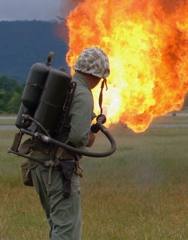
Flamethrowers are not regulated under U.S. federal firearms law—but state and local laws vary, and use is heavily restricted.
Related:
- Can You Believe It’s Legal: Dueling Laws
- Can You Believe It’s Legal: Selling Human Body Parts
- Can You Believe It’s Legal: Owning Exotic Pets
- Can You Believe It’s Legal? Unpaid Internships
- Can You Believe It’s Legal? For-Profit Prisons
- Can You Believe It’s Legal? Payday Loans
- Can You Believe It’s Legal? Civil Asset Forfeiture
What is The Law on Flamethrowers?
Do you own a lighter? What about a butane torch? If you said yes to either of those, then you own a tiny flamethrower. Is anyone knocking down your door to take you to jail? Probably not. And they most likely won’t either.
Does this mean you can go around setting your neighborhood on fire? No. Imagine using a lighter to set a neighbor’s house on fire. Just because you can own one, doesn’t mean it can be used to do harm to others.
50-State Flamethrower Law Table (State-Level Snapshot)
| State | State-level ownership status | What to note (common restrictions that still apply) |
|---|---|---|
| Alabama | No specific state statute identified | Fire codes, burn bans, arson/reckless endangerment laws, local ordinances |
| Alaska | No specific state statute identified | Fire restrictions, public endangerment laws, local rules |
| Arizona | No specific state statute identified | Burn bans + wildfire rules can make use illegal; local ordinances |
| Arkansas | No specific state statute identified | Fire codes, arson statutes, local restrictions |
| California | Explicitly regulated (permit framework for devices meeting definition) | CA defines “flamethrowing device” as projecting a burning stream of flammable liquid ≥10 feet; permit requirements apply. (Justia) |
| Colorado | No specific state statute identified | Seasonal burn bans; wildfire/forest restrictions; local ordinances |
| Connecticut | No specific state statute identified | Local fire codes; public safety/endangerment laws |
| Delaware | No specific state statute identified | Fire code + arson/reckless conduct statutes; local rules |
| Florida | No specific state statute identified | Controlled-burn rules, fire codes, and local ordinances are often the limiting factor |
| Georgia | No specific state statute identified | Burn bans, fire codes, local ordinances |
| Hawaii | No specific state statute identified | Fire safety rules are typically strict; local restrictions likely significant |
| Idaho | No specific state statute identified | Burn bans + wildfire restrictions; local rules |
| Illinois | No specific state statute identified | Fire codes + nuisance laws often apply locally |
| Indiana | No specific state statute identified | Fire code, arson/reckless endangerment laws, local ordinances |
| Iowa | No specific state statute identified | Fire codes, burn restrictions, local ordinances |
| Kansas | No specific state statute identified | Burn bans, fire codes, local restrictions |
| Kentucky | No specific state statute identified | Fire codes + criminal misuse statutes |
| Louisiana | No specific state statute identified | Fire codes; local ordinances; arson statutes |
| Maine | No specific state statute identified | Fire code + local rules; seasonal burn restrictions |
| Maryland | Explicitly prohibited/treated as “destructive device” under state law | MD includes flamethrowers in “destructive device” definition; related provisions restrict manufacture/possession/use. (Justia) |
| Massachusetts | No specific state statute identified | Fire codes; local ordinances; reckless endangerment laws |
| Michigan | No specific state statute identified | Local ordinances may exist; fire code + misuse laws |
| Minnesota | No specific state statute identified | Fire codes; burn bans; local ordinances |
| Mississippi | No specific state statute identified | Fire code + arson statutes; local rules |
| Missouri | No specific state statute identified | Burn bans, fire codes, local ordinances |
| Montana | No specific state statute identified | Wildfire restrictions; burn bans; local rules |
| Nebraska | No specific state statute identified | Burn bans + fire codes; local ordinances |
| Nevada | No specific state statute identified | Burn bans + wildfire rules; local ordinances |
| New Hampshire | No specific state statute identified | Fire codes; local rules; misuse laws |
| New Jersey | No specific state statute identified | Local fire codes; public safety statutes; local ordinances |
| New Mexico | No specific state statute identified | Burn bans + wildfire restrictions; local ordinances |
| New York | No specific state statute identified | Local rules can be stricter (especially cities); fire codes + misuse laws |
| North Carolina | No specific state statute identified | Burn bans, fire codes, local ordinances |
| North Dakota | No specific state statute identified | Fire codes; local restrictions; misuse laws |
| Ohio | No specific state statute identified | Fire codes; local ordinances; reckless endangerment laws |
| Oklahoma | No specific state statute identified | Burn bans, fire codes, local ordinances |
| Oregon | No specific state statute identified | Wildfire restrictions + burn bans; local ordinances |
| Pennsylvania | No specific state statute identified | Local fire codes; public safety statutes; ordinances |
| Rhode Island | No specific state statute identified | Fire code + local rules; misuse laws |
| South Carolina | No specific state statute identified | Burn bans, fire codes, local ordinances |
| South Dakota | No specific state statute identified | Fire codes; local restrictions; misuse laws |
| Tennessee | No specific state statute identified | Fire codes; burn bans; local ordinances |
| Texas | No specific state statute identified | Burn bans (county-level), arson/reckless endangerment laws, local ordinances |
| Utah | No specific state statute identified | Wildfire/burn restrictions; local ordinances |
| Vermont | No specific state statute identified | Fire code + local rules; misuse laws |
| Virginia | No specific state statute identified | Fire codes; burn bans; local ordinances |
| Washington | No specific state statute identified | Wildfire restrictions; burn bans; local ordinances |
| West Virginia | No specific state statute identified | Fire codes; local ordinances; misuse laws |
| Wisconsin | No specific state statute identified | Fire codes; burn restrictions; local ordinances |
| Wyoming | No specific state statute identified | Wildfire restrictions; burn bans; local rules |
State Overview: Flamethrower Laws in the U.S.
While flamethrowers are not regulated under U.S. federal firearms law, state and local laws vary—sometimes significantly. In many cases, ownership may be legal, but use is restricted under fire codes, arson statutes, or local ordinances.
Below is a partial overview of notable state approaches. This is not legal advice, and local city or county rules may be stricter.
Check out National Fire Protection Association NFPA for a list of codes and standards.
States with Explicit Restrictions or Definitions
- California
California law defines a flamethrower and restricts devices capable of projecting a flame more than 10 feet. While ownership is not outright banned, sale, manufacture, and certain uses are regulated, and misuse can result in serious criminal penalties. - Maryland
Flamethrowers fall under broader “destructive device” and fire-related statutes. Ownership may be legal, but use in public or residential areas can violate state and local laws.
States Where Flamethrowers Are Generally Legal to Own (Use Still Restricted)
- Texas
Texas has no statute specifically banning flamethrower ownership. However, use can still violate arson, reckless endangerment, or burn ban laws, especially during drought conditions. - Florida
Ownership is generally legal, but use is heavily regulated under fire safety laws, controlled burn rules, and local ordinances. - Arizona
Flamethrowers are not explicitly banned, but use during fire restrictions or in populated areas may lead to criminal charges.
States Where Local Laws Matter Most
- New York
No statewide ban, but cities and counties may restrict possession or use, particularly within city limits. - Illinois
State law does not specifically prohibit flamethrowers, but local fire codes and nuisance laws frequently apply.
Important Legal Reality Check
Even in states where flamethrowers are legal to own:
- Discharging one can still constitute arson, reckless endangerment, or criminal mischief
- Use may violate fire codes, environmental laws, or burn bans
- Homeowners’ insurance often excludes coverage for damages caused by incendiary devices
- Cities, HOAs, and counties can impose stricter rules than the state
Bottom line:
Legality is not just about ownership—it’s about where, when, and how a flamethrower is used.
What is the History of Flamethrowers?
Throwing fire at people to cause harm has been around for a long time. It all started with Greek fire. Then the people figured out a way to shoot that Greek fire out into a crowd.
In modern times, they were quite useful during world wars. There is nothing like a fire bearing down on you to scare you. Flamethrowers are psychological weapons that can also leave nasty scars. Considering the combustible nature of the fluids and gases in a flamethrower, they are also dangerous to the user.
There are basically two types of flamethrowers: “stage fire” flamethrowers and military-grade. Military-grade sprays hydrogen and gelatinized fuel. The fuel can land on something and continue to burn. This is why it was good as a weapon. “Stage fire” flamethrowers shoot out a flame significantly cooler than military-grade. The fire is also not designed to stick.
There are also flamethrowers made from lighters and hairspray cans. However, those are very dangerous as the fire can enter the can and blow it up because hairspray provides its own oxygen for the flame. Don’t do it.
How do you Obtain a Flamethrower?
There are basically two ways to get a flamethrower. You can either buy one or make one. You can buy professionally made flamethrowers online for a decent price. These are made to be as safe as a flamethrower can be.
Improvised or homemade flamethrowers are extremely dangerous and may violate local laws.
What are Flamethrowers Used For?
Besides the previously mentioned use of a flamethrower as a weapon, there are other uses for a flamethrower. Deadly insects are hard to kill when they are in swarms. Flamethrowers can kill them quickly. This has been useful against angry bee swarms. Flamethrowers are also useful for clearing out brush and, ironically, making an area less susceptible to fire. They have also been used for clearing out snakes and getting rid of snow in city streets.
What is The reality of Owning a Flamethrower?
There is a cold reality to owning a flamethrower. They are filled with highly combustible materials. If any fires were to erupt near them, there would be a chance of an explosion. They produce large amounts of fire, one of the deadliest forces known to man. The fires they produce are sometimes uncontrollable.
The truth is flamethrowers are deadly. Unlike a gun that might fire a single bullet that might hit someone, if a flamethrower accidentally goes off, things are going to burn. People are going to burn.
Flamethrowers come in two different “flavors”: deadly and even more deadly. They can be bought online. They can be made at your kitchen table. This is all true. But the question you should ask yourself is this: Even though flamethrowers are legal, do you really want to own one? Unless you are fighting off a swarm of “killer bees,” do you have a good reason to own one? A lighter is a much safer tool.
This article is informational only and not legal advice. Local ordinances may be stricter than state law.
Related:
What states are flamethrowers legal in?
Top 12 Paralegal Degree Specializations
Top 25 Best Value Online Paralegal Certificates
